Galvanic Cells and Thermodynamic Applications - Complete Interactive Lesson
Part 1: Introduction to Galvanic Cells
⚡ Galvanic Cells — Redox Review
Part 1 of 7 — Half-Reactions and Electron Transfer
Topics in This Part
| Section |
|---|
| 🔄 Redox Review |
| Oxidation and Reduction |
| Oxidation Numbers |
| Identifying Redox |
| ✍️ Writing Half-Reactions |
🔑 Key Concept: Mastering this material will strengthen your foundation for both the AP Chemistry exam and more advanced chemistry topics.
What You'll Master in Part 1
- Understanding the core concepts covered in Part 1
- Applying these ideas to solve practice problems
- Building toward AP exam readiness for this topic
🔄 Redox Review
Oxidation and Reduction
| Term | Definition | Electrons | Mnemonic |
|---|---|---|---|
| Oxidation | Loss of electrons | Electrons leave | OIL (Oxidation Is Loss) |
| Reduction | Gain of electrons | Electrons arrive | RIG (Reduction Is Gain) |
🔑 Key Concept: Remember OIL RIG — Oxidation Is Loss, Reduction Is Gain.
Oxidation Numbers
Oxidation numbers (states) help track electron transfer:
- Elements in standard state: 0
- Monatomic ions: charge = oxidation number
- O is usually −2 (except peroxides: −1)
- H is usually +1 (except metal hydrides: −1)
- Sum of oxidation numbers = charge of species
Identifying Redox
- The species that is oxidized is the reducing agent (it reduces something else)
- The species that is reduced is the oxidizing agent (it oxidizes something else)
✍️ Writing Half-Reactions
Every redox reaction can be split into two half-reactions — one for oxidation and one for reduction.
Worked Example
Overall Reaction:
Oxidation half-reaction (anode):
Zinc loses 2 electrons — oxidation number changes from to .
Reduction half-reaction (cathode):
Copper gains 2 electrons — oxidation number changes from to .
Key Points
- Electrons must balance — the number lost in oxidation equals the number gained in reduction
- The electrode where oxidation occurs is the anode
- The electrode where reduction occurs is the cathode
🔑 Key Concept — AN OX, RED CAT:
ANode = OXidation | REDuction = CAThode
Redox Fundamentals Quiz 🎯
Oxidation State Practice 🧮
Determine the oxidation state of the underlined element:
1) The oxidation state of Mn in is:
2) The oxidation state of Cr in is:
3) The oxidation state of N in is:
Redox Terminology 🔽
Exit Quiz — Redox Review ✅
Part 2: Cell Notation & Diagrams
🔋 Galvanic Cell Structure
Part 2 of 7 — Salt Bridges, Electron Flow, and Ion Flow
Topics in This Part
| Section |
|---|
| 🏗️ Anatomy of a Galvanic Cell |
| The Two Half-Cells |
| Key Components |
| The Zn-Cu Cell (Daniell Cell) |
| 🔀 Flow Directions |
🔑 Key Concept: Mastering this material will strengthen your foundation for both the AP Chemistry exam and more advanced chemistry topics.
What You'll Master in Part 2
- Understanding the core concepts covered in Part 2
- Applying these ideas to solve practice problems
- Building toward AP exam readiness for this topic
🏗️ Anatomy of a Galvanic Cell
The Two Half-Cells
A galvanic cell consists of two half-cells, each containing:
- An electrode (solid conductor, often a metal)
- An electrolyte solution (containing the relevant ions)
Key Components
| Component | Function |
|---|---|
| Anode | Electrode where oxidation occurs (negative terminal) |
| Cathode | Electrode where reduction occurs (positive terminal) |
| Salt bridge | Allows ion flow to maintain electrical neutrality |
| External wire | Carries electrons from anode to cathode |
The Zn-Cu Cell (Daniell Cell)
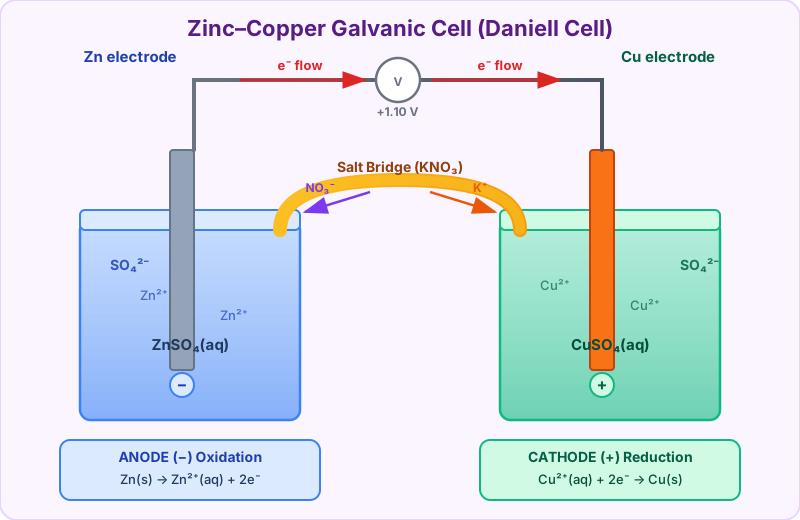
Anode (oxidation):
Cathode (reduction):
Overall:
🔀 Flow Directions
⚡ Electron Flow (through the wire)
Electrons flow from anode to cathode through the external circuit.
🧂 Ion Flow (through the salt bridge)
| Ion Type | Direction | Examples |
|---|---|---|
| Anions (−) | Migrate toward the anode | , |
| Cations (+) | Migrate toward the cathode | , |
🤔 Why Is the Salt Bridge Necessary?
Without a salt bridge, the cell would stop working almost immediately.
Here's why:
- The anode solution would become too positive (excess produced)
- The cathode solution would become too negative ( consumed)
- This charge imbalance would halt the reaction
The salt bridge maintains electrical neutrality by allowing ion migration between the two half-cells.
± Anode Sign Convention
In a galvanic cell:
- Anode = negative terminal (−)
- Cathode = positive terminal (+)
⚠️ This is opposite to electrolytic cells!
Cell Structure Quiz 🎯
Cell Component Identification 🔽
Cell Analysis 🧮
For a galvanic cell with the overall reaction:
1) Which metal is the anode? (type the element symbol)
2) Which metal is the cathode? (type the element symbol)
3) How many electrons are transferred in the balanced reaction?
Exit Quiz — Cell Structure ✅
Part 3: Standard Reduction Potentials
⚡ Standard Reduction Potentials
Part 3 of 7 — E° and Calculating Cell Voltage
Topics in This Part
| Section |
|---|
| ⚡ Standard Reduction Potential Table |
| 🔢 Calculating Standard Cell Potential |
| ⚠️ Important Rules |
| 🧪 Worked Example: Zn-Cu Cell |
🔑 Key Concept: Mastering this material will strengthen your foundation for both the AP Chemistry exam and more advanced chemistry topics.
What You'll Master in Part 3
- Understanding the core concepts covered in Part 3
- Applying these ideas to solve practice problems
- Building toward AP exam readiness for this topic
⚡ Standard Reduction Potential Table
All half-reactions are written as reductions (gaining electrons):
| Half-Reaction | (V) |
|---|---|
| (reference) | |
🔑 Key Concept — Reading the Table:
- More positive : stronger tendency to be reduced (stronger oxidizing agent)
- More negative : stronger tendency to be oxidized (stronger reducing agent)
- The Standard Hydrogen Electrode (SHE) is the reference: V
🔢 Calculating Standard Cell Potential
🔑 The Master Equation:
⚠️ Important Rules
| # | Rule |
|---|---|
| 1 | values are NOT multiplied by stoichiometric coefficients — they are intensive properties |
| 2 | The species with the higher (more positive) is reduced (cathode) |
| 3 | The species with the lower (more negative) is oxidized (anode) |
| 4 | A spontaneous galvanic cell always has |
⚠️ Warning: Never multiply values by stoichiometric coefficients. is an intensive property — it does not change when you scale the equation.
🧪 Worked Example: Zn-Cu Cell
Problem: Calculate for a Zn-Cu galvanic cell.
- Cathode: ( V)
- Anode: ( V)
Solution:
✅ The positive confirms the reaction is spontaneous.
Reduction Potential Quiz 🎯
Cell Potential Calculations 🧮
Standard Reduction Potentials:
Half-Reaction (V)
1) for a cell with Ag cathode and Fe anode: (in V, to 3 significant figures)
2) for a cell with Cu cathode and Ni anode: (in V, to 3 significant figures)
3) for a cell with Ni cathode and Fe anode: (in V, to 3 significant figures)
Reduction Potential Concepts 🔽
Exit Quiz — Standard Reduction Potentials ✅
Part 4: Calculating E°cell
📝 Cell Notation (Line Notation)
Part 4 of 7 — Shorthand for Electrochemical Cells
Topics in This Part
| Section |
|---|
| 📝 Cell Notation Rules |
| The Format |
| Conventions |
| Example: Daniell Cell |
| ⭐ Special Cases in Cell Notation |
🔑 Key Concept: Mastering this material will strengthen your foundation for both the AP Chemistry exam and more advanced chemistry topics.
What You'll Master in Part 4
- Understanding the core concepts covered in Part 4
- Applying these ideas to solve practice problems
- Building toward AP exam readiness for this topic
📝 Cell Notation Rules
The Format
Conventions
| Symbol | Meaning |
|---|---|
| (single line) | Phase boundary (solid/liquid, liquid/gas, etc.) |
| (double line) | Salt bridge |
| Anode on the left | Oxidation half-cell |
| Cathode on the right | Reduction half-cell |
| Concentrations in parentheses | e.g., M |
🔑 Key Concept: Read cell notation left to right — anode (oxidation) → salt bridge → cathode (reduction).
Example: Daniell Cell
Read left to right:
- Zn solid electrode (anode)
- Phase boundary
- ions in solution
- Salt bridge
- ions in solution
- Phase boundary
- Cu solid electrode (cathode)
⭐ Special Cases in Cell Notation
🔩 Inert Electrodes
When a half-reaction involves only aqueous species (no solid metal), we use an inert electrode — typically Pt (platinum) or C (graphite):
Example:
The comma separates species in the same phase.
💨 Gas Electrodes
For reactions involving gases, the gas contacts the Pt electrode and is separated by a phase boundary:
Example:
The gas bubbles over the Pt surface.
🎯 Key Points for AP
| Rule | Detail |
|---|---|
| Anode position | Always on the left |
| Cathode position | Always on the right |
| Species order | Listed as they appear in the half-reaction |
| (single line) | Phase boundary |
| (double line) | Salt bridge |
| Comma | Separates species in the same phase |
Cell Notation Quiz 🎯
Reading Cell Notation 🧮
For the cell:
1) Which metal is the anode? (element symbol)
2) Which metal is the cathode? (element symbol)
3) How many electrons are transferred in the balanced reaction? ( needs , needs )
Cell Notation Elements 🔽
Exit Quiz — Cell Notation ✅
Part 5: Spontaneity & ΔG°
🔗 Connecting Free Energy and Cell Potential
Part 5 of 7 —
Topics in This Part
| Section |
|---|
| 🔑 The Key Equation |
| 🤔 Why the Negative Sign? |
| 📏 Unit Check |
| 🔗 The Thermodynamic Triangle |
| 🗺️ The Web of Connections |
🔑 Key Concept: Mastering this material will strengthen your foundation for both the AP Chemistry exam and more advanced chemistry topics.
What You'll Master in Part 5
- Understanding the core concepts covered in Part 5
- Applying these ideas to solve practice problems
- Building toward AP exam readiness for this topic
🔑 The Key Equation
The bridge between thermodynamics and electrochemistry:
| Symbol | Meaning | Units |
|---|---|---|
| Standard free energy change | J (or kJ) | |
| Moles of electrons transferred | dimensionless | |
| Faraday's constant | C/mol | |
| Standard cell potential | V (volts = J/C) |
🤔 Why the Negative Sign?
| Condition | ||
|---|---|---|
| Spontaneous | ||
| At equilibrium | ||
| Non-spontaneous |
The negative sign ensures these are always opposite in sign — positive gives negative . ✓
📏 Unit Check
💡 The units work out to joules. Divide by 1000 to convert to kJ.
🔗 The Thermodynamic Triangle
Three key relationships connect , , and :
Master Equations:
At 25°C (298 K):
🗺️ The Web of Connections
| Know | Want | Use |
|---|---|---|
✅ All Three Must Be Consistent
| Spontaneous? | |||
|---|---|---|---|
| Yes | |||
| At equilibrium | |||
| No |
💡 If you know any one of these three values, you can determine the other two!
🧪 Worked Example
Daniell Cell:
V, mol
📐 Calculate
📐 Calculate at 298 K
🔥 This enormous confirms the reaction is virtually complete at equilibrium — products are overwhelmingly favored.
and Quiz 🎯
Thermodynamic Triangle Calculations 🧮
1) V, . Calculate in kJ. (to 1 decimal)
2) kJ, . Calculate in V. (to 3 significant figures)
3) If for a cell, is greater than or less than 1? (type "greater" or "less")
Connecting the Three Quantities 🔽
Exit Quiz — and ✅
Part 6: Problem-Solving Workshop
🛠️ Problem-Solving Workshop — Galvanic Cells
Part 6 of 7 — Practice and Integration
Practice Makes Perfect
This workshop features multi-step problems that mirror the AP Chemistry exam format. Each problem requires you to combine concepts from previous parts and show your work clearly.
🔑 Why this matters: The AP Chemistry exam rewards students who can apply concepts to unfamiliar problems — structured practice is the best preparation.
What You'll Master in Part 6
- Working through complete multi-step problems from start to finish
- Building problem-solving strategies you can apply on the AP exam
- Identifying which concepts to apply and in what order
🛠️ Problem-Solving Strategy
Step-by-Step Approach
🔑 Key Concept: Follow this systematic approach for every galvanic cell problem:
- Identify the two half-reactions
- Determine which is oxidized (anode) and which is reduced (cathode) using values
- Calculate
- Balance electrons (find )
- Calculate if needed
- Write cell notation if asked
Common Mistakes to Avoid
⚠️ Warning: These are the most frequent errors on the AP exam:
| Mistake | Correction |
|---|---|
| Multiplying by coefficients | is intensive — never multiply |
| Flipping the sign of when reversing a reaction | Use instead |
| Using °C instead of K for temperature | Always convert to Kelvin |
| Forgetting to convert from J to kJ | C/mol gives J; divide by 1000 |
Mixed Galvanic Cell Problems 🎯
Given: V, V, V, V
Calculation Workshop 🧮
Given: V, V
For the cell: Fe(s) | || | Cu(s)
1) (in V, to 3 significant figures)
2) (electrons transferred)
3) (in kJ, to nearest whole number)
Cell Analysis 🔽
For the cell: Al(s) | || | Ag(s)
Given: = −1.66 V, = +0.80 V
Exit Quiz — Problem-Solving Workshop ✅
| Half-Reaction | (V) |
|---|---|
Part 7: Synthesis & AP Review
🎯 Synthesis & AP Review — Galvanic Cells
Part 7 of 7 — Mastery Check
Bringing It All Together
This comprehensive review connects every concept from Parts 1–6 with AP-style problems. The questions are designed to mirror what you'll see on the actual exam — multi-step, multi-concept, and requiring clear written explanations.
🔑 Why this matters: AP Chemistry exam questions rarely test one concept in isolation — success requires connecting ideas across topics.
What You'll Master in Part 7
- Solving AP-style questions that integrate multiple concepts from this unit
- Writing clear, concise explanations using proper chemistry terminology
- Identifying and avoiding common AP exam traps and mistakes
📋 Master Summary
Essential Equations
| Equation | Purpose |
|---|---|
| Calculate cell voltage | |
| Connect free energy to voltage | |
| Connect voltage to equilibrium (at 25°C) |
🔑 Key Equations — Memorize These:
Cell Components
| Component | Role | Memory Aid |
|---|---|---|
| Anode | Oxidation | AN OX (left in notation) |
| Cathode | Reduction | RED CAT (right in notation) |
| Salt bridge | Maintains neutrality | Ions flow, not electrons |
| Wire | Carries electrons | Anode → Cathode |
Spontaneity Criteria
🔑 Key Concept: These three quantities are always linked — know one, know them all.
| Quantity | Spontaneous | Equilibrium | Nonspontaneous |
|---|---|---|---|
Comprehensive AP Review 🎯
Given: = −0.76 V, = +0.34 V, = +0.80 V, = −0.44 V
Integration Problems 🧮
1) A cell has V and . What is in kJ? (to nearest whole number)
2) A cell has kJ and . What is in V? (to 3 significant figures)
3) If V and at 298 K, is greater or less than 1? (type "greater" or "less")
Final Concept Review 🔽
Final Exit Quiz — Galvanic Cells Mastery ✅